How anxiety affects your bladder and bowel
Incontinence Advice

In Ihrem Warenkorb:
Es befinden sich noch keine Artikel in Ihrem Warenkorb.
Quantity: ZULETZT HINZUGEFÜGTE ARTIKEL Artikel gesamt: Summe: Zum WarenkorbWe help you
In our FAQ you will find answers to the most frequently asked questions. Here you can also find out the easiest way to contact us.
Customer serviceActive living
If you're planning to take a flight, a long drive, or a train journey and you're worried about bladder leaks, toilet access, or long stretches without a break, you're not alone.
Travelling with incontinence is completely manageable. In fact, the difference between a stressful journey and a more relaxed one often comes down to getting your preparation right.

This quick guide walks you through simple ways to plan, pack, and manage incontinence while travelling. It will help you focus more on enjoying your trip rather than worrying about bladder leaks.
Key Takeaways
Travel days can increase urgency or leaks, but this doesn't mean you are managing your bladder poorly.
Here are some of the common triggers:
This is why a little extra preparation can make such a difference. When you're in an unfamiliar environment, being ready can help you feel more comfortable and confident.
A little planning before you leave home can go a long way towards reducing uncertainty and helping you travel with confidence.
Before you head out, it helps to:
Knowing where toilets are and roughly how long you'll be without access can remove much of the uncertainty that often causes pre-travel anxiety.
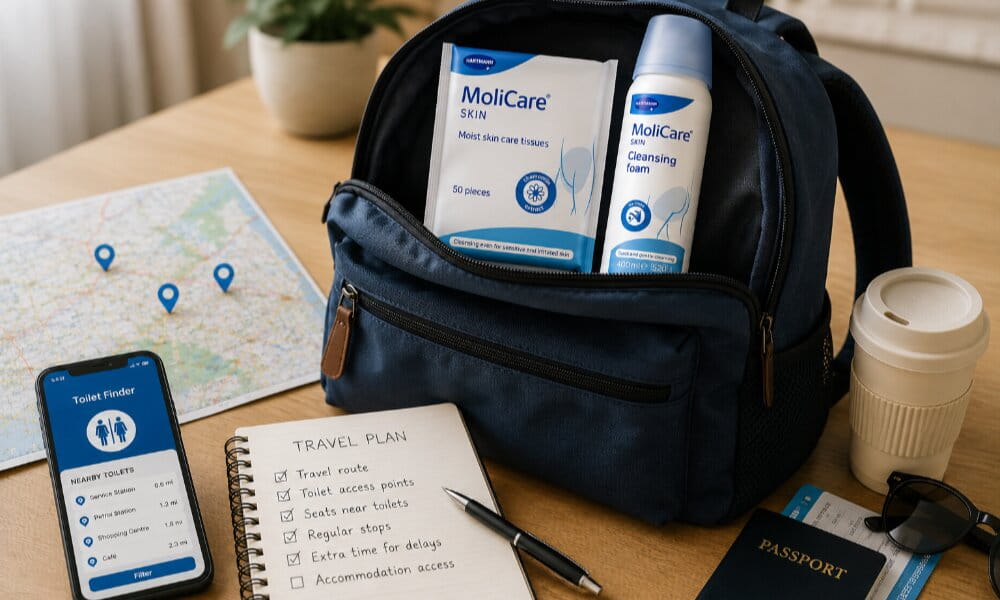
A well-prepared travel kit can be one of the biggest confidence boosters you pack. Keep essentials split between your hand luggage for quick access and your main luggage for backup supplies.
Here is a travel packing checklist to help you stay prepared:
| Item | Where to Pack It |
|---|---|
| Spare pads/underwear for the journey | Hand luggage |
| Backup supplies for the full trip | Main luggage |
| Wipes and disposal bags | Hand luggage, easily accessible |
| Skin care, such as barrier cream or cleansing wipes | Hand luggage |
| Higher absorbency protection for long-haul flights | Hand luggage |
MoliCare® offers different levels and styles of incontinence protection depending on the type of travel, how long you expect to be away from facilities, and the level of bladder leakage you are managing.
These are a few examples many travellers choose for added confidence while away from home. The right incontinence products will depend on your usual level of bladder leakage, the length of your journey, and how predictable access to bathrooms will be along the way.
Tip: Incontinence products such as pads and protective underwear are generally treated as personal hygiene items and are permitted in carry-on luggage. Liquids like barrier creams or cleansing foams over 100ml should go in checked luggage, or be limited to travel-sized containers in your carry-on liquids bag.
If your trip includes connections by road or rail, it helps to plan for the entire journey rather than treating each stage separately. Delays, platform changes, traffic, and limited access to facilities can all make travel days longer than expected.
| Travel Type | Main Challenge | Practical Solution |
|---|---|---|
| Flights | Limited toilet access and long periods of sitting | Choose an aisle seat, visit the toilet before boarding, and use longer-wear protection. |
| Road trips | Unpredictable stops | Schedule regular breaks and use service stations to change protection if needed. |
| Train or coach travel | Shared or limited toilet facilities | Choose a seat near the toilet and keep a discreet travel kit close to hand. |
Beyond planning and packing, comfort plays a big role in how confident you feel during travel days.
Sitting for extended periods while wearing protection can be tougher on your skin than a normal day at home, so it's worth paying a little extra attention to skin care while travelling.
Products within the MoliCare® Skin Care range can help keep skin feeling clean and comfortable. MoliCare® Skin 3in1 Wet Wipes, Moist Skin Care Tissues, and Cleansing Foam are designed for gentle cleansing and freshening up during stopovers or airport bathroom breaks.
For longer journeys, MoliCare® Skin Protect Barrier Cream can help support the skin's natural barrier by creating an additional layer of protection where skin may be exposed to prolonged moisture.
Even with the best planning, leaks can still happen. What matters most is how you respond.
Having spare clothing and supplies ready in advance can turn an unexpected leak from a stressful moment into a quick, manageable routine.
Travelling with incontinence is absolutely possible, and for most people it becomes much easier with the right planning. There's no single right way to travel with bladder weakness – the key is finding a routine and products that give you confidence.
Whether that's a discreet pad for a short flight or longer-wear protection for a long-haul journey, MoliCare® offers a range of products designed to suit different levels of absorbency and travel needs.
Find Travel-Friendly Protection
The best choice depends on your usual level of bladder leakage and the length of your journey. For short trips or light leaks, slim everyday pads are often enough. For longer journeys or moderate to heavy leakage, absorbent underwear or pull-up pants with higher absorbency can provide longer wear between changes.
Rather than cutting back on fluids, which can increase bladder irritation and urgency, it helps to drink normally but spread your fluid intake evenly throughout the day. Using the toilet before boarding or departing and choosing protection suited to the length of your journey can also help you travel more comfortably.
Planning seats near toilets, taking proactive bathroom breaks instead of waiting until you feel urgency, and wearing protection that provides reassurance between changes can all help reduce the stress of frequent toilet urges during longer journeys.
An incontinence device generally refers to products such as pads, absorbent underwear, or pull-up pants that are designed to manage bladder leaks, rather than a single piece of equipment. Most travellers simply need well-fitting, appropriately absorbent protection together with a few hygiene essentials packed for the journey.